
What Is 1 Pip in Gold? XAUUSD Pip Value Explained
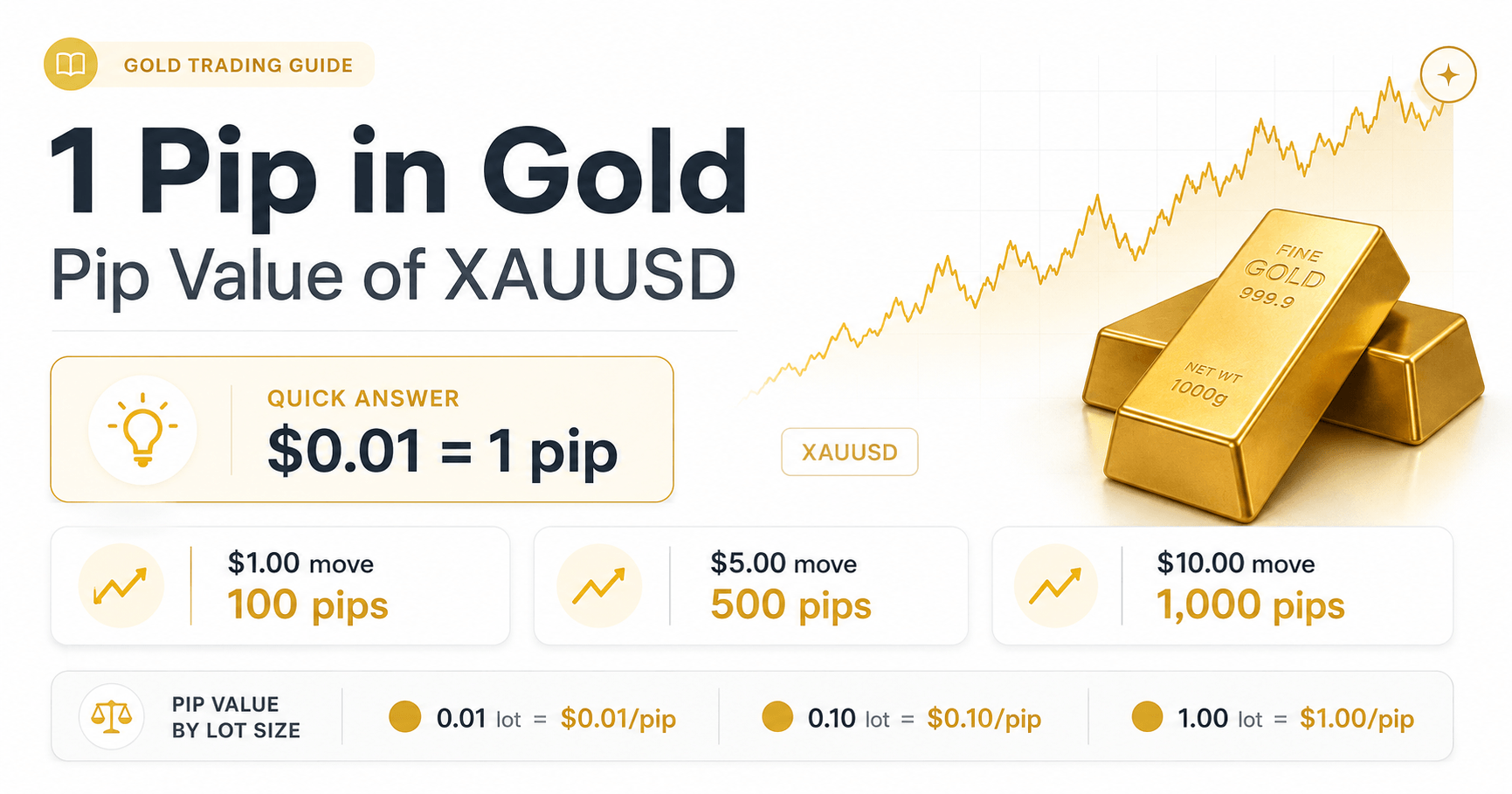
If you are trying to understand 1 pip in Gold or find the pip value of XAUUSD, the first thing to know is that Gold does not have one universally used pip convention. On this site, we use 1 pip = a $0.01 movement in XAUUSD. With a standard 100-troy-ounce contract, that makes one pip worth about $1 at 1.00 lot, $0.10 at 0.10 lot, and $0.01 at 0.01 lot.
Using the $0.01 convention, 1 pip in Gold (XAUUSD) = $0.01 of price movement. Therefore, a move from 4350.00 to 4350.01 is 1 pip, a $1.00 move is 100 pips, and a $10.00 move is 1,000 pips. The dollar value of those pips depends on your lot size.
What Is 1 Pip in Gold?
Gold is commonly traded as XAUUSD, which represents Gold priced in US dollars per troy ounce.
Under the convention used throughout this guide, one Gold pip is a $0.01 change in the XAUUSD price. If Gold moves from 4350.00 to 4350.01, that is one pip. If it moves from 4350.00 to 4351.00, the price has moved $1.00, which equals 100 pips.
Why Do Traders Give Different Answers for a Gold Pip?
This is where Gold pip calculations can become confusing. Unlike the traditional pip convention used for many currency pairs, the word pip is not used consistently for XAUUSD across every broker, trading platform, calculator, or trading community.
You may see $0.01 described as one pip on one platform, while another source treats $0.10 as one pip. You may also hear Gold traders describe full-dollar price moves without using pips at all.
That does not necessarily mean one calculation is mathematically wrong. It often means the sources are using different terminology for the same underlying price movement.
| Convention | What Is Called 1 Pip | Value at 1.00 Lot* |
|---|---|---|
| $0.01 convention | $0.01 Gold movement | $1 |
| $0.10 convention | $0.10 Gold movement | $10 |
*Assumes a standard XAUUSD contract size of 100 troy ounces. Broker specifications can differ.
For consistency: every calculation on this page uses 1 pip = $0.01. Before using pip values for a live trade, check the contract size, tick size, tick value, and pricing convention shown by your own broker.
Why Decimal Places Alone Do Not Define a Gold Pip
The number of decimals shown in an XAUUSD quote can affect the smallest displayed price increment, but decimal precision by itself does not determine what a broker calls one pip. A platform may quote Gold to two or three decimal places while still using a separate pip, point, or tick convention in its contract specification.
For that reason, do not assume that the last decimal place automatically equals one pip. Instead, check the instrument specification for contract size, tick size, tick value, and the broker’s own pip or point terminology.
| What You See | What It Tells You | What It Does Not Guarantee |
|---|---|---|
| 2-decimal quote | Price is displayed to $0.01 | That $0.01 must be called 1 pip |
| 3-decimal quote | Price is displayed to $0.001 | That $0.001 must be called 1 pip |
| Broker specification | Actual contract and tick details | Nothing — this is the final reference |
The safest comparison between brokers is the actual dollar movement in XAUUSD and the resulting monetary change in your position, not the pip count alone.
What Is the Pip Value of XAUUSD?
The pip value of XAUUSD tells you how much money a one-pip Gold price movement is worth for your position.
Pip size and pip value are not the same thing. Under our convention, the pip size remains $0.01, but the monetary value of that pip changes with your lot size.
If your broker uses the common standard contract size of 100 troy ounces for 1.00 lot, the calculation is:
Pip Value = Pip Size × Contract Size × Lot Size
For example, using a $0.01 pip size and a 100-ounce standard contract:
$0.01 × 100 oz × 1.00 lot = $1.00 per pip
XAUUSD Pip Value by Lot Size
The table below shows how much one XAUUSD pip is worth at common Gold lot sizes when 1 pip = $0.01 and 1.00 lot = 100 troy ounces.
| Lot Size | Lot Type | Gold Exposure* | Value of 1 Pip | Value of 100 Pips | Value of 1,000 Pips |
|---|---|---|---|---|---|
| 0.01 lot | Micro lot | 1 oz | $0.01 | $1 | $10 |
| 0.05 lot | Micro lot | 5 oz | $0.05 | $5 | $50 |
| 0.10 lot | Mini lot | 10 oz | $0.10 | $10 | $100 |
| 0.50 lot | Mini lot | 50 oz | $0.50 | $50 | $500 |
| 1.00 lot | Standard lot | 100 oz | $1.00 | $100 | $1,000 |
*Based on a 100-troy-ounce standard contract, where 1.00 lot is a standard lot, 0.10 lot is a mini lot, and 0.01 lot is a micro lot. Naming conventions can vary by broker — always confirm the XAUUSD contract specification your broker actually uses.
Using Pip Value to Size a Gold Position
Knowing the pip value of XAUUSD is most useful when you turn it into a lot size that matches how much you actually want to risk. The formula below converts a risk amount and a stop-loss distance (in pips) into the lot size that keeps your loss within that risk amount if the stop is hit.
Lot Size = Risk Amount ÷ (Stop-Loss in Pips × Pip Value at 1.00 Lot)
Worked Example
Risk amount = 1% of $5,000 = $50
Stop-loss distance = $5.00 = 500 pips (using the $0.01 convention)
Pip value at 1.00 lot = $1.00 per pip under this guide’s assumptions
Lot size = $50 ÷ (500 × $1.00) = 0.10 lot
Result: approximately 0.10 lot before spread, commission, slippage, or other trading costs
The wider your stop-loss, the smaller the lot size needs to be to keep the same dollar risk. Because a normal XAUUSD price move can translate into hundreds of pips under the $0.01 convention, it is safer to size the trade from the actual stop distance and account risk rather than reuse a pip-count habit from another instrument.
Rather than running this formula by hand for every trade, you can plug your account size, risk percentage, and stop-loss into our Gold lot size calculator and get the recommended lot size directly.
If you would rather calculate a specific trade instead of doing the math manually, our XAUUSD Pip Value Calculator lets you enter a Gold price move, pip amount, and lot size to calculate the result directly.
How to Calculate Pips in Gold
To calculate the number of pips between two Gold prices, subtract one price from the other and divide the absolute price difference by the pip size.
Number of Pips = |Exit Price − Entry Price| ÷ 0.01
XAUUSD: 4350.00 → 4351.00
Price movement = $1.00
$1.00 ÷ $0.01 = 100 pips
XAUUSD: 4350.00 → 4355.00
Price movement = $5.00
$5.00 ÷ $0.01 = 500 pips
XAUUSD: 4350.00 → 4360.00
Price movement = $10.00
$10.00 ÷ $0.01 = 1,000 pips
Common Gold Pip Conversions
If you use the $0.01 convention, these are useful XAUUSD conversions to remember.
| Gold Price Movement | Number of Pips |
|---|---|
| $0.01 | 1 pip |
| $0.10 | 10 pips |
| $0.50 | 50 pips |
| $1.00 | 100 pips |
| $5.00 | 500 pips |
| $10.00 | 1,000 pips |
| $20.00 | 2,000 pips |
How Much Is 100 Pips in Gold?
Using a $0.01 pip size, 100 pips in Gold equals a $1.00 XAUUSD price movement.
The amount of money that $1.00 move represents depends on your position size. With a 100-ounce standard contract, 100 pips is worth approximately:
| Lot Size | 100 Pips | Gold Price Move |
|---|---|---|
| 0.01 lot | $1 | $1.00 |
| 0.10 lot | $10 | $1.00 |
| 1.00 lot | $100 | $1.00 |
Gold Pip vs Forex Pip: Why It Trips Up New Gold Traders
If you learned to trade on currency pairs like EUR/USD or GBP/USD, the word “pip” already means something specific to you: a movement in the 4th decimal place, equal to $0.0001. Gold does not follow that rule, and assuming it does is one of the most common mistakes traders make when they first size a Gold position.
| Instrument | Standard Pip Size | Decimal Place |
|---|---|---|
| EUR/USD, GBP/USD, AUD/USD | $0.0001 | 4th decimal |
| USD/JPY | ¥0.01 | 2nd decimal |
| XAUUSD (Gold, this guide’s convention) | $0.01 | 2nd decimal |
In practice, this means a stop-loss habit built on currency pairs (for example, “a 20-pip stop is normal”) does not transfer directly to Gold. A 20-pip stop on EUR/USD is a 0.0020 price move, while a 20-pip stop on Gold under the $0.01 convention is only a $0.20 move — a much tighter stop than most Gold traders actually use. Always convert in dollar terms first, then translate to pips, rather than reusing a pip count from another instrument.
Pip vs Point in XAUUSD
The terms pip, point, and tick are sometimes used differently between Gold brokers and trading platforms. This is one reason two traders can describe the same XAUUSD movement using different numbers.
The safest approach is to focus first on the actual Gold price change. A move from 4350.00 to 4351.00 is always a $1.00 movement per troy ounce, regardless of what a platform chooses to call that movement.
You can then convert that price movement into pips using the convention used by your broker or calculator.
How to Check Your Broker’s XAUUSD Pip Value
Before calculating risk or profit for a live Gold trade, open the specification or contract details for XAUUSD inside your trading platform and check:
- Contract size
- Tick size
- Tick value
- Number of decimal places quoted
- Minimum lot size
On MetaTrader platforms, this information is typically available in the symbol or instrument specification. These values are more useful than relying on a generic definition of a Gold pip because they show how your actual broker calculates the instrument.
Remember: the most important number for managing a trade is the actual monetary change in your position when XAUUSD moves. Pip terminology is useful shorthand, but your broker’s contract specification determines the actual monetary value for your account.
Frequently Asked Questions
What is 1 pip in Gold?
Using the convention on this page, 1 pip in Gold is a $0.01 movement in XAUUSD. For example, a move from 4350.00 to 4350.01 equals one pip. Some brokers and traders use different Gold pip conventions, so check your broker’s specifications.
What is the pip value of XAUUSD?
The pip value of XAUUSD depends on the pip size, contract size, and lot size. Assuming a $0.01 pip and a standard contract of 100 troy ounces, one pip is worth $1 at 1.00 lot, $0.10 at 0.10 lot, and $0.01 at 0.01 lot.
How much is 1 pip in Gold for 0.01 lot?
With a 100-ounce standard contract and a $0.01 pip convention, a 0.01-lot XAUUSD position represents approximately one ounce of Gold. A one-pip movement is therefore worth approximately $0.01.
How much is 1 pip in Gold for 0.10 lot?
Assuming the same 100-ounce standard contract and $0.01 pip, a 0.10-lot position represents approximately 10 ounces. One pip is therefore worth approximately $0.10.
How much is 1 pip in Gold for 1 lot?
If 1.00 standard lot represents 100 troy ounces and one pip equals a $0.01 movement, one Gold pip is worth approximately $1 at 1.00 lot.
How many pips is a $1 move in Gold?
Using the $0.01 convention, a $1.00 movement in XAUUSD equals 100 pips because $1.00 divided by $0.01 equals 100.
How many pips is a $10 move in Gold?
A $10.00 move in XAUUSD equals 1,000 pips when one Gold pip is defined as a $0.01 price movement.
Is 1 Gold pip $0.01 or $0.10?
Both conventions can be found in Gold trading. This page uses $0.01 as one pip, but some brokers, calculators, and traders use $0.10. Always check the XAUUSD contract specification and terminology used by your own broker before calculating a trade.
Does Gold pip value change with lot size?
Yes. The underlying Gold price movement represented by a pip stays the same under a chosen convention, but the monetary value increases as your position size increases. A larger lot size controls more Gold, so the same price movement produces a larger profit or loss.
Is a Gold pip the same as a forex pip?
No. Most currency pairs measure a pip as a $0.0001 movement (the 4th decimal place), while XAUUSD under the $0.01 convention measures a pip two decimal places earlier. Reusing a pip-based stop-loss habit from currency pairs on Gold without converting it can result in a very different dollar risk than intended.
How do I use pip value to calculate my Gold position size?
Divide your risk amount by your stop-loss distance in pips multiplied by the pip value at 1.00 lot. Under this guide’s assumptions, 1.00 lot is worth $1 per pip, so $50 ÷ (500 × $1) = 0.10 lot. Always confirm your broker’s contract specification before using the result.
