
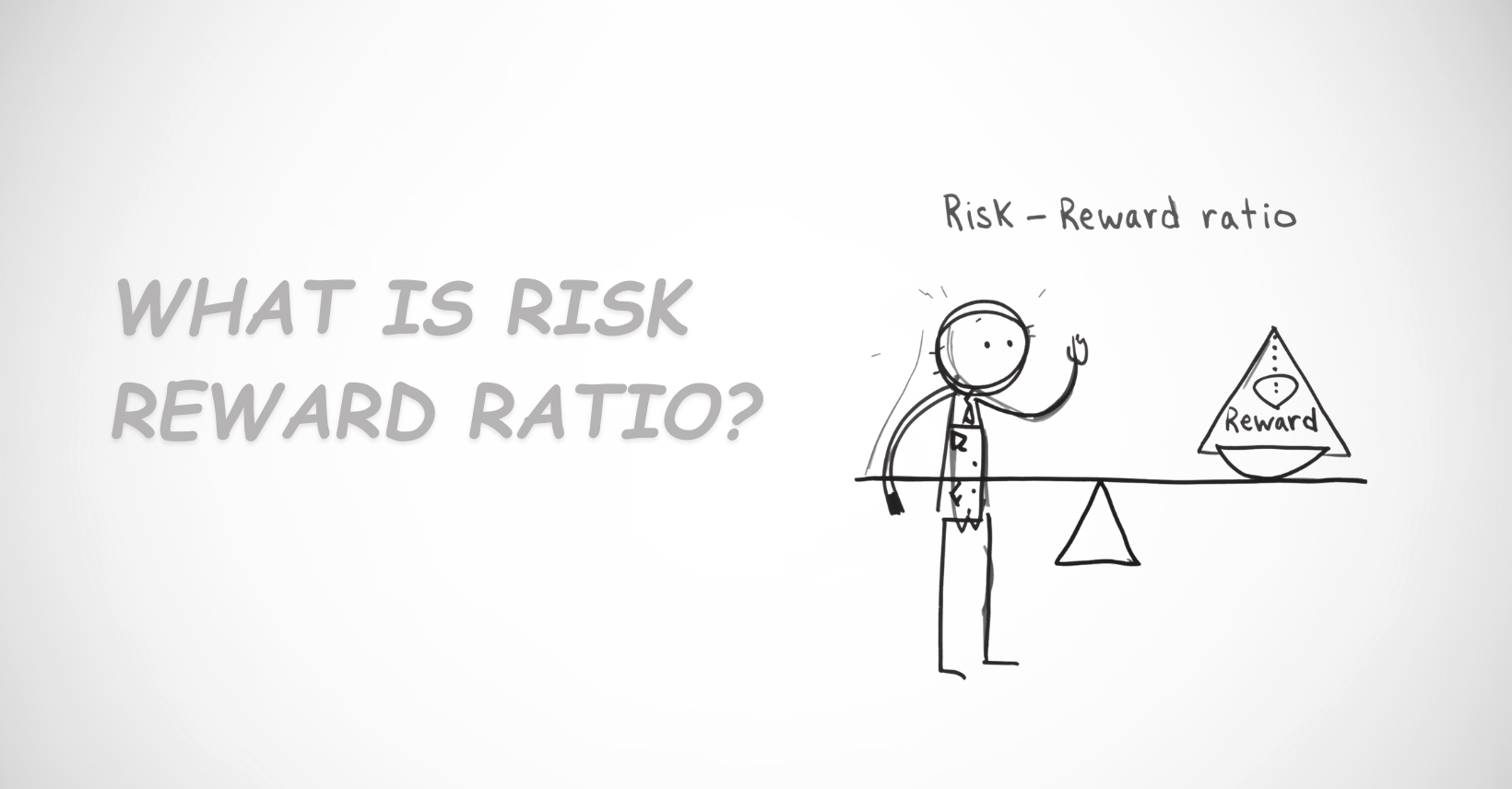
Risk reward ratio is a fundamental concept in trading and investing that defines the relationship between the amount of money a trader is prepared to lose and the amount of money the trader aims to gain on a single position. It functions as a structured evaluation metric that determines whether a trade offers a favorable balance between potential loss and potential profit. Rather than focusing only on entry timing or prediction accuracy, risk reward ratio frames each trade in terms of controlled downside and measurable upside.
In professional trading practice, risk reward ratio carries more long-term importance than finding a perfect signal. A system with a modest win rate can still generate consistent returns when the average reward meaningfully exceeds the average risk. In contrast, a strategy with frequent winning trades can still produce negative results if each loss outweighs each gain. The ratio directly shapes the mathematical expectancy of a trading approach across forex, stocks, cryptocurrencies, and commodities.
Definition of Risk Reward Ratio
Risk reward ratio is the numerical comparison between potential loss and potential profit within a defined trade structure. It answers the essential question: how much capital is exposed relative to the anticipated return if the trade reaches its objective.
The ratio is expressed in the format:
Risk : Reward
For example, a 1:2 risk reward ratio indicates that one unit of capital is at risk for the opportunity to gain two units. The calculation is not speculative. It is derived from predefined price levels, specifically the entry price, the stop-loss level, and the take-profit level. These three elements create a measurable framework for evaluating trade efficiency.
Risk Reward Ratio in Simple Terms
In simplified terms, risk reward ratio measures trade efficiency and proportional balance. It reveals whether the expected return justifies the defined exposure.
If a trader risks 50 dollars to potentially earn 150 dollars, the ratio is 1:3.
If a trader risks 200 dollars to potentially earn 100 dollars, the ratio is 2:1.
The first example reflects asymmetric advantage in favor of reward. The second example reflects greater exposure than potential gain. The ratio therefore acts as a filter that helps eliminate structurally unfavorable trades before capital is committed.
Risk Reward Ratio Formula
The standard formula is:
Risk Reward Ratio = Potential Loss / Potential Profit
Two components are required for calculation:
Risk, defined as the monetary or price distance between entry and stop-loss.
Reward, defined as the monetary or price distance between entry and take-profit.
The ratio emerges directly from measurable price movement rather than subjective expectation.
Calculation Structure of Risk Reward Ratio
Three values are required:
Entry price
Stop-loss price
Take-profit price
Step 1: Determine Risk
Risk equals the distance between entry and stop-loss.
Example:
Entry: 1.2000
Stop-loss: 1.1980
Risk: 20 pips
Step 2: Determine Reward
Reward equals the distance between entry and take-profit.
Example:
Entry: 1.2000
Take-profit: 1.2060
Reward: 60 pips
Step 3: Express the Ratio
20 : 60 simplifies to 1 : 3
This structure indicates that one unit is exposed for the possibility of gaining three units.
Illustrative Risk Reward Ratio Structures
| Structure | Risk | Reward | Meaning |
|---|---|---|---|
| 1:1 Ratio | Risk: 100 | Reward: 100 | Equal exposure and potential return. Requires higher win rate for profitability. |
| 1:2 Ratio | Risk: 100 | Reward: 200 | Reward is double the exposure. |
| 1:3 Ratio | Risk: 100 | Reward: 300 | Strong asymmetry favoring potential return. |
| 2:1 Ratio | Risk: 200 | Reward: 100 | Exposure exceeds potential gain and requires unusually high accuracy to remain profitable. |
Importance of Risk Reward Ratio in Trading Systems
Risk reward ratio defines long-term viability. Trading performance is not determined solely by win frequency. It depends on the statistical interaction between win rate, average gain, and average loss. The ratio directly controls the magnitude of average outcomes.
When reward consistently exceeds risk, losing streaks become mathematically survivable. Capital preservation improves because no single trade dominates overall results. Over time, consistent application of favorable ratios builds structural advantage even without predictive precision.
Relationship Between Risk Reward Ratio and Win Rate
The ratio cannot be evaluated in isolation. Profitability depends on the interaction between reward magnitude and success frequency.
Example using 1:2 ratio:
Loss: -100
Win: +200
If two losses occur and one win occurs:
Total losses: -200
Total gains: +200
Net result: break-even
Under this structure, a trader needs to win only one out of three trades to avoid net loss. The higher the reward relative to risk, the lower the required win rate for sustainability.
Break-Even Win Rate by Ratio
1:1 ratio requires approximately 50 percent win rate.
1:2 ratio requires approximately 33 percent win rate.
1:3 ratio requires approximately 25 percent win rate.
2:1 ratio requires approximately 67 percent win rate.
These percentages illustrate why many professional systems prefer ratios of at least 1:2. Lower win frequency can still produce neutral or positive outcomes when reward magnitude compensates for losses.
Characteristics of a Good Risk Reward Ratio
There is no universally optimal ratio. Suitability depends on strategy type, volatility, and time horizon. However, common structural benchmarks include:
1:1 for balanced short-term trades
1:1.5 for moderate expectancy systems
1:2 as a widely accepted professional baseline
1:3 or greater for trend-driven or breakout environments
A 1:2 ratio often represents a practical balance between realistic price objectives and favorable long-term expectancy.
Limitations of High Ratios
Higher ratios do not automatically imply superior performance. As reward targets move further from entry, probability of reaching them typically declines.
A 1:1 structure positions take-profit closer to entry, increasing likelihood of execution.
A 1:5 structure positions take-profit significantly further, decreasing statistical hit rate.
Effective ratio selection must align with volatility, structure, and probability. Impressive numerical ratios have little value if price rarely reaches projected targets.
Application Across Markets
Forex Trading
In currency markets, ratios are commonly measured in pips. Stop-loss and take-profit placement is based on structural levels such as support, resistance, volatility bands, session ranges, and liquidity concentrations. For example, risking 20 pips to target 40 pips creates a 1:2 structure. Because forex often involves leverage, disciplined ratio planning is critical to avoid disproportionate account impact.
Stock Trading
In equities, calculation is typically expressed in dollar movement. Example:
Entry: 50
Stop-loss: 48
Take-profit: 56
Risk: 2
Reward: 6
Ratio: 1:3
Equity trends and breakout conditions can support larger reward multiples, making asymmetric setups structurally attractive.
Cryptocurrency Trading
Cryptocurrency markets exhibit elevated volatility. Rapid directional swings increase both opportunity and exposure. Ratios such as 1:2 or 1:3 are frequently used to justify participation in volatile price expansion while limiting downside risk through defined stops.
Commodity Trading
Commodities such as gold and oil respond to macroeconomic catalysts and geopolitical events. A trader risking 300 points to target 600 points maintains a 1:2 relationship. Because volatility can expand abruptly, predefined ratio planning is central to capital protection.
Distinction Between Risk Reward Ratio and Risk Management
Risk reward ratio addresses structural balance within an individual trade. Risk management encompasses broader account-level controls including position sizing, percentage exposure per trade, drawdown limits, and capital preservation rules.
A favorable ratio cannot compensate for excessive position size. Both structural ratio and exposure discipline must function together to sustain long-term stability.
Influence of Stop-Loss and Take-Profit Placement
Stop-loss placement defines risk magnitude. Excessively wide stops inflate exposure and weaken ratios. Excessively narrow stops increase premature exit probability. Placement must correspond to structural invalidation points rather than cosmetic ratio targets.
Take-profit placement defines reward magnitude. Logical placement includes prior highs and lows, resistance levels, liquidity pools, or projected continuation targets. Unrealistic targets distort statistical probability and reduce overall expectancy.
Risk Reward Ratio and Trading Style
Scalping often uses ratios such as 1:1, 1:1.5, or 1:2 due to compressed timeframes and limited price movement.
Swing trading frequently pursues 1:2, 1:3, or 1:4 structures because broader price swings provide extended reward potential.
Style selection influences feasible ratio design.
Psychological and Behavioral Impact
Defined ratios reduce impulsive behavior. Predetermined exposure discourages holding losses indefinitely or exiting gains prematurely. By quantifying both maximum loss and expected gain prior to entry, traders reduce emotional interference and increase structural consistency.
Risk Reward Ratio and Expectancy
Expectancy represents the long-term average outcome of a trading system. When average reward exceeds average risk across sufficient sample size, positive expectancy becomes possible. Risk reward ratio directly contributes to this statistical foundation by magnifying gains relative to losses.
Risk Reward Ratio and Reward to Risk Ratio
The terms are conceptually identical but expressed inversely.
Risk Reward Ratio expresses exposure first: 1:2 means risking one to gain two.
Reward to Risk Ratio expresses gain first: 2:1 means gaining two for every one risked.
Both describe the same proportional relationship, differing only in presentation format.
Risk Reward Ratio Summary
Risk reward ratio is a quantitative measurement that compares defined potential loss to defined potential gain within a trade. It is calculated using the distance between entry, stop-loss, and take-profit levels and expressed as a proportional relationship such as 1:2 or 1:3. Its significance lies in shaping long-term profitability by balancing win frequency with average outcome size. Sustained trading performance does not require high accuracy if reward magnitude consistently exceeds exposure. For this reason, risk reward ratio remains a foundational structural element in professional trading methodology.