

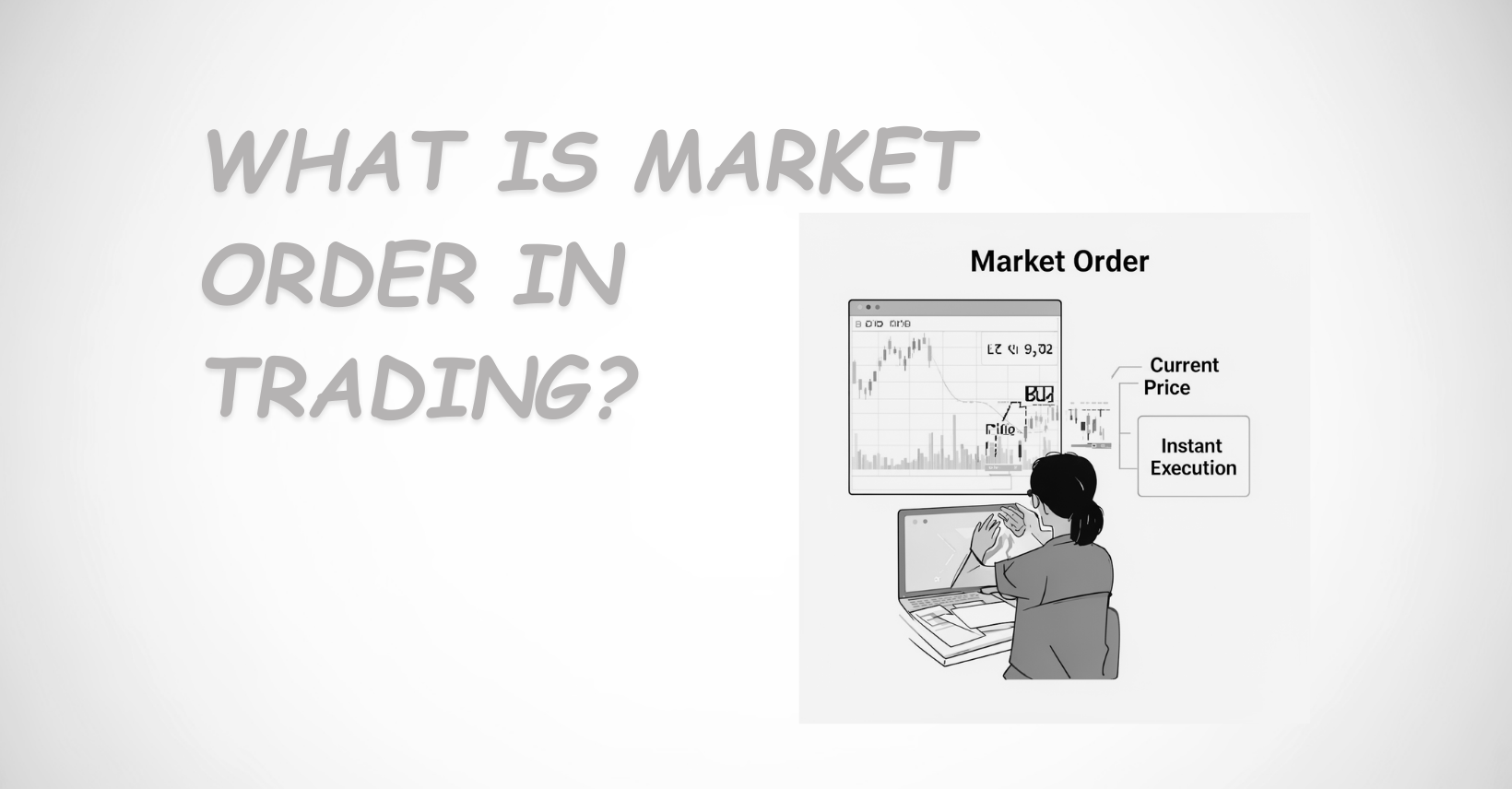
A market order in trading is a direct instruction given to a broker or trading exchange to buy or sell a financial instrument immediately at the best available current market price.
It is classified as the fastest execution order type because it places priority on speed of execution rather than price precision.
When a trader submits a market order, they are agreeing to transact at whatever price is currently offered in the market at the exact moment the order is matched and filled.
Market orders are commonly used across forex trading, stock trading, cryptocurrency trading, futures markets, and CFD trading environments because they allow immediate entry or exit from a position.
Due to this immediate execution structure, the market order is considered one of the most foundational and universally recognized order types in global financial markets.
The primary purpose of a market order is to secure immediate participation in the market when timing is more critical than achieving a specific entry or exit price.
Although market orders are typically executed within seconds or milliseconds, they do not guarantee that the trader will receive the exact price displayed on the chart at the moment of submission.
This difference becomes more noticeable during periods of high volatility or Liquidity.
Definition of Market Order in Trading
A market order is defined as a buy or sell request that is executed instantly at the best available bid or ask price currently listed in the market.
Unlike a limit order, which requires a specified price condition before execution, a market order contains no price restriction.
Instead, it instructs the trading system to fill the order immediately using the available liquidity in the order book.
How Market Orders Are Executed
When a trader places a market order, the broker or exchange automatically matches the request with the closest available opposing orders.
If the trader submits a buy order, execution occurs at the current ask price.
If the trader submits a sell order, execution occurs at the current bid price.
The core characteristic that defines a market order is its execution priority.
It is structured to complete the trade without delay, even if the final execution price varies slightly from the trader’s expected price due to real-time market fluctuations.
Practical Meaning of a Market Order in Trading
In practical trading terms, a market order represents a decision to prioritize certainty of execution over certainty of price.
The trader is effectively choosing immediate market participation, even if the final filled price differs marginally from what was observed seconds earlier.
Market orders are frequently applied in situations such as confirmed breakouts, sudden reversals, rapid volatility spikes, momentum continuation setups, and urgent capital protection scenarios.
In each of these contexts, speed becomes more valuable than waiting for a precise entry level.
Active strategies such as scalping and intraday trading depend heavily on market orders due to their need for immediate order placement.
However, long-term investors may also use market orders when they prefer guaranteed execution over waiting for a retracement to a specific level.
How a Market Order Functions in the Market
A market order functions through direct interaction with the order book, which contains existing buy and sell orders at various price levels.
Financial markets operate through the continuous matching of buyers and sellers.
At any given time, there are participants willing to transact at different prices.
When a market order is submitted, the trading system immediately matches it with the nearest available opposite orders.
Small orders are typically filled at a single price level if sufficient liquidity exists.
Larger orders may consume multiple price levels, leading to partial fills at different prices.
This can result in a blended average execution price.
Because price levels in the order book change constantly, a market order does not guarantee a fixed execution price.
In fast-moving markets, prices may shift within milliseconds between order submission and execution.
Bid Price, Ask Price, and Spread
The bid price represents the highest price buyers are currently willing to pay.
The ask price represents the lowest price sellers are currently willing to accept.
A market buy order executes at the ask price.
A market sell order executes at the bid price.
The numerical difference between the bid and ask price is called the spread.
The spread functions as a transactional cost and is particularly relevant in forex and CFD markets.
Since market orders execute at bid or ask, traders automatically incur the spread upon entering or exiting a position.
Types of Market Orders
Market Buy Order
A market buy order is an immediate instruction to purchase an asset at the best available ask price.
It is typically used when a trader anticipates upward price movement and requires instant entry.
Market Sell Order
A market sell order is an immediate instruction to sell an asset at the best available bid price.
It is used when downward price movement is expected or when a trader wants to exit a long position without delay.
Market Order to Open a Position
This refers to initiating a new trade using immediate execution at current market prices.
Market Order to Close a Position
This refers to exiting an existing trade instantly at the prevailing bid or ask price.
Execution Characteristics and Slippage
Slippage refers to the difference between the expected execution price and the actual filled price.
It occurs when price movement or insufficient liquidity prevents execution at the originally displayed rate.
For example, if a trader expects to buy at 1.2000 but receives execution at 1.2003, the 3-pip difference represents slippage.
Slippage can be negative or positive, depending on whether the execution price is worse or better than expected.
Slippage risk increases during high-impact economic news releases, geopolitical events, sudden liquidity withdrawals, or sharp volatility expansions.
Market Order Compared to Other Order Types
Market Order vs Limit Order
A market order executes immediately at the best available price.
A limit order executes only at a specified price or better.
Market orders prioritize speed, while limit orders prioritize price precision.
Market Order vs Stop Order
A stop order becomes a market order once a predetermined trigger price is reached.
Once activated, it behaves like a market order and can still experience slippage.
Application Across Financial Markets
Forex Trading
Market orders are heavily used in forex due to high liquidity and continuous pricing.
Execution depends on broker infrastructure and liquidity provider access.
Stock Trading
In centralized exchanges, market orders are filled according to the exchange order book.
Liquidity conditions vary depending on the stock’s trading volume.
Cryptocurrency Trading
Crypto markets often experience higher volatility and variable liquidity.
Large market orders may be filled across multiple levels, affecting average price.
Futures and CFD Trading
Leverage and rapid price movement make immediate execution essential.
However, spread widening during volatile conditions can influence fill quality.
Liquidity and Volatility Considerations
Liquidity refers to the number of active buy and sell orders at different price levels.
Higher liquidity results in tighter spreads and smoother execution.
Lower liquidity increases the chance of price impact and partial fills.
Volatility measures the speed and magnitude of price changes.
During high volatility, market orders are more likely to experience execution variation due to rapid price adjustments.
Core Characteristics of a Market Order
Executes immediately
Uses current available price levels
Does not guarantee exact execution price
Subject to slippage
Affected by liquidity and volatility
Fills at bid or ask depending on direction
Prioritizes speed over price precision
Comprehensive Definition of a Market Order
A market order in trading is an execution-focused order type that instructs a broker or exchange to buy or sell a financial asset instantly at the best available price within the current order book.
It is a foundational trading mechanism used across forex, stocks, cryptocurrencies, futures, and CFDs.
The defining principle of a market order is immediate execution without price restriction, making it suitable for scenarios where timing and certainty of participation outweigh price accuracy considerations.