
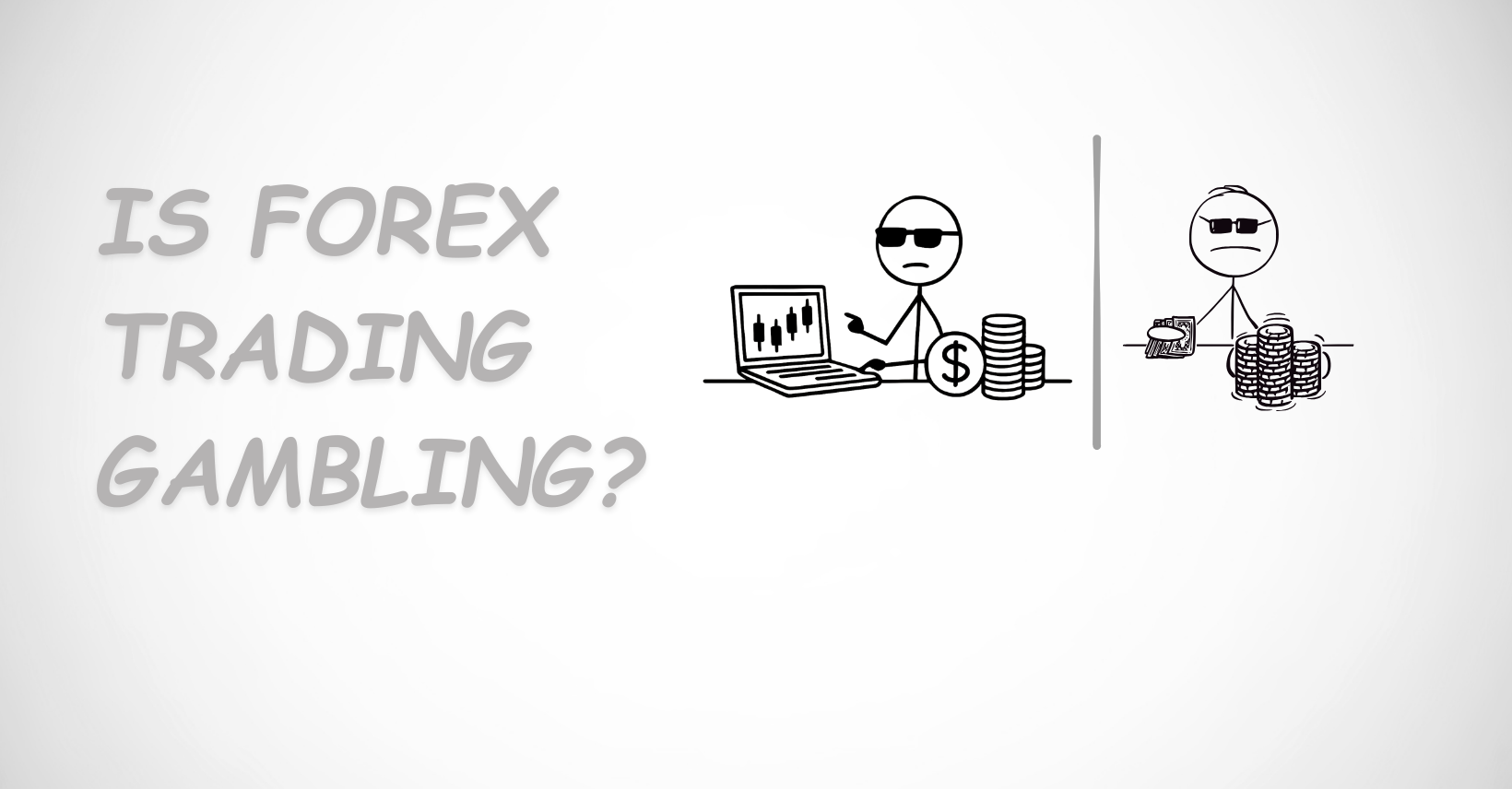
Forex trading is frequently misunderstood, particularly by beginners who are just entering the financial markets. One of the most common questions people ask before opening their first trade is simple and direct: is forex trading gambling?
The question makes sense. Forex trading involves real money, measurable risk, and uncertain outcomes. Prices move up and down, profits are never guaranteed, and losses are possible. On the surface, that can look similar to gambling.
However, whether forex trading is considered gambling depends entirely on how it is approached, structured, and executed. The activity itself is financial in nature. The behavior of the participant determines whether it becomes speculation based on skill or gambling based on chance.
This document provides a complete definition and detailed explanation of forex trading, gambling, their differences, and the specific conditions under which forex trading can resemble gambling behavior.
Is Forex Trading Gambling?
Forex trading is not inherently gambling. It is a global financial market activity based on currency exchange, economic data, and probability-based speculation.
Forex trading becomes gambling only when conducted without structure, without Risk Management, and without analytical decision-making.
The classification depends on behavior.
Definition of Forex Trading
Forex trading, also known as foreign exchange trading, is the structured buying and selling of national currencies within the global currency market.
Participants in the forex market aim to profit from fluctuations in exchange rates between currency pairs. Examples of commonly traded currency pairs include:
EUR/USD (Euro versus US Dollar)
GBP/USD (British Pound versus US Dollar)
USD/JPY (US Dollar versus Japanese Yen)
The forex market operates twenty-four hours per day, five days per week, and is recognized as the largest financial market in the world by trading volume. It includes banks, financial institutions, hedge funds, corporations, governments, and retail traders.
Forex trading is based on analyzing economic data, monetary policy decisions, interest rates, inflation reports, employment statistics, geopolitical events, Liquidity flows, and technical price structures. When approached professionally, forex trading is a structured financial activity built on probability and risk management principles.
Definition of Gambling
Gambling is defined as the act of risking money or valuables on an uncertain outcome that is primarily determined by chance rather than skill.
In gambling environments:
The participant has minimal control over the outcome.
The odds are statistically designed to favor the operator or house.
Decisions are often made without analytical advantage.
Long-term losses are mathematically expected for the average participant.
Common examples of gambling include slot machines, roulette, lottery games, and sports betting conducted without research or statistical modeling.
The defining characteristic of gambling is reliance on randomness without a measurable or repeatable edge.
Core Distinction Between Forex Trading and Gambling
The fundamental difference between forex trading and gambling lies in the source of decision-making and control.
Forex trading, when executed properly, is skill-based and probability-driven.
Gambling, by definition, is chance-based and structurally tilted against the participant.
In structured forex trading, measurable factors influence decisions, including:
macroeconomic indicators
market structure
liquidity zones
probability-based setups
Risk Management frameworks
trading psychology discipline
In gambling, structured probability advantage rarely exists for the participant. The statistical edge generally belongs to the house.
Nature of Risk in Forex Trading
Risk is present in both forex trading and gambling. However, the management and structure of that risk differ significantly.
In professional forex trading:
Risk per trade is predefined.
Position size is calculated according to account balance and stop-loss distance.
Losses are limited through protective mechanisms such as Stop Loss orders.
Risk Reward Ratio are evaluated before trade execution.
In gambling behavior:
Risk is frequently undefined.
Position Sizing is often emotional or impulsive.
Losses are chased rather than controlled.
There is no structured exit plan.
The presence of risk alone does not classify an activity as gambling. The absence of structured control over risk does.
Role of Leverage
Leverage is a financial tool that allows traders to control larger positions using smaller capital.
In forex trading, leverage can amplify profits and losses proportionally. When used with proper position sizing and calculated exposure, leverage is a risk-adjusted instrument.
When used excessively or without understanding position sizing principles, leverage converts trading into account-level betting. In such cases, a single trade can significantly damage or eliminate capital. This misuse of leverage aligns more closely with gambling behavior than professional trading.
Skill Versus Luck in Forex Trading
Forex trading contains uncertainty, but uncertainty does not equal randomness.
Market movements are influenced by:
central bank interest rate decisions
inflation releases
employment reports
institutional liquidity flows
global economic conditions
technical supply and demand imbalances
Professional traders rely on preparation, statistical probability, historical pattern recognition, disciplined execution, and structured frameworks. Short-term outcomes may vary, but long-term performance reflects skill, consistency, and risk management.
Luck may affect isolated trades. Sustainable profitability depends on repeatable processes.
Conditions Under Which Forex Trading Becomes Gambling
Forex trading transitions into gambling behavior when structure and discipline are removed.
Common indicators of gambling behavior in trading include:
Entering trades without a documented plan.
Failing to define stop-loss and take-profit levels.
Risking excessive percentages of capital on single trades.
Increasing position size after losses to recover quickly.
Trading impulsively without confirmation criteria.
Holding losing trades without protective exits.
Opening frequent trades without quality setups.
Trading for emotional stimulation rather than structured opportunity.
When trading decisions are driven by hope, excitement, fear, or urgency instead of predefined rules, the activity mirrors gambling psychology.
Professional Forex Trading Characteristics
Forex trading remains a legitimate financial activity when it functions as a structured business process.
Professional trading includes:
A defined trading strategy with entry and exit criteria.
Measured risk per trade, often between 0.5 percent and 2 percent of account capital.
Calculated position sizing based on stop-loss distance.
Consistent risk-to-reward evaluation.
Performance tracking through trade journaling.
Acceptance of losses as statistical business expenses.
Long-term focus on probability rather than individual outcomes.
A trading strategy may include elements such as trend confirmation, support and resistance levels, breakout structures, liquidity sweeps, reversal patterns, and secondary indicator confirmation. The strategy is applied consistently, not randomly.
Probability and Trading Edge
In structured forex trading, profitability does not require winning every trade. It requires maintaining a statistical edge.
A trading edge is defined as a method that produces positive expectancy over a large sample of trades. Positive expectancy occurs when average profits exceed average losses across repeated executions.
This concept mirrors institutional probability modeling rather than casual betting behavior. The trader’s objective is long-term expectancy, not immediate certainty.
Risk-to-Reward Framework
Risk-to-reward ratio measures the relationship between potential loss and potential gain.
For example, risking 50 units of currency to potentially gain 150 units reflects a 1:3 risk-to-reward ratio. With consistent application, even a moderate win rate can generate profitability.
In gambling scenarios, participants frequently risk more than the potential gain or ignore structured ratios entirely.
Psychological Discipline
Psychological stability differentiates professional trading from gambling behavior.
Professional traders:
accept losses without emotional escalation
avoid revenge trading
maintain consistent position sizing
avoid impulsive decisions
adhere strictly to documented systems
Gambling behavior typically includes emotional reactions, loss-chasing, and impulsive doubling of exposure.
Moral and Religious Interpretation
In moral or religious discussions, forex trading may be labeled gambling when it involves reckless speculation, greed-driven risk-taking, addictive behavior, or financial harm.
When conducted with education, calculated risk, moderate leverage, and disciplined methodology, forex trading is generally categorized as structured financial speculation rather than gambling.
The ethical concern typically centers on behavior and intention rather than the market mechanism itself.
Career Legitimacy
Forex trading can function as a legitimate career when supported by:
a tested and documented strategy
consistent execution over extended periods
controlled and sustainable risk management
measurable performance tracking
emotional discipline
long-term profitability metrics
The misconception that forex trading is gambling often arises because many participants approach the market without preparation, education, or structured methodology.
Conclusion Definition
Forex trading is not inherently gambling. It is a global financial market activity based on currency exchange, economic data, and probability-based speculation.
Forex trading becomes gambling only when conducted without structure, without risk management, and without analytical decision-making.
The classification depends on behavior.
When approached as a disciplined financial practice, forex trading is skill-based and structured.
When approached as impulsive speculation driven by emotion or hope, it becomes gambling behavior.
Key Definitions Summary
Forex trading: structured currency exchange activity based on analysis and risk management.
Gambling: risking money on outcomes primarily determined by chance.
Professional trading: probability-driven decision-making with controlled risk.
Gambling behavior in trading: emotional, unstructured, and uncontrolled risk exposure.
Long-term forex profitability: dependent on discipline, statistical edge, and consistent execution rather than luck.