
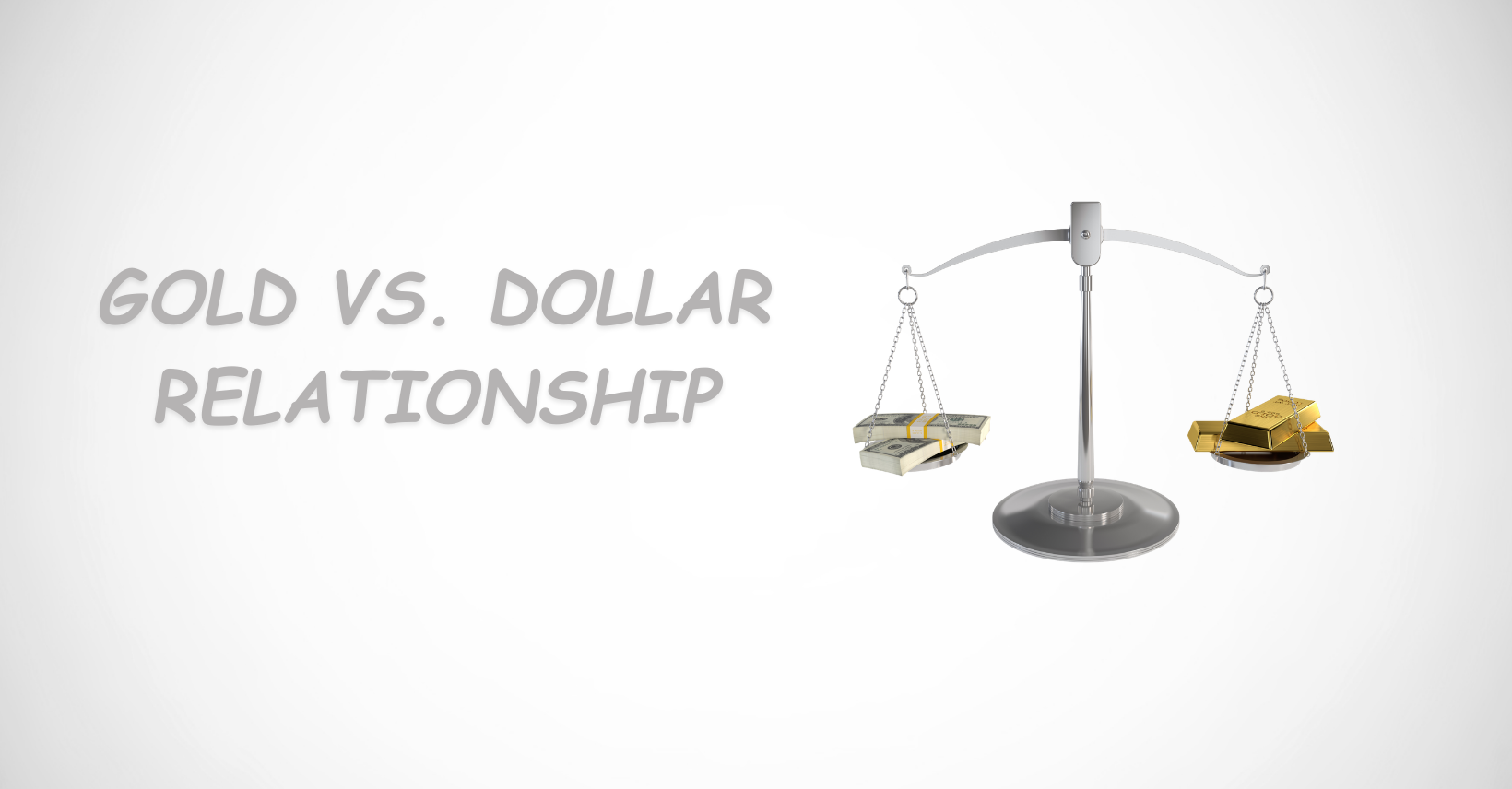
The gold vs dollar relationship is a foundational concept in global finance that defines how gold prices and the value of the U.S. dollar interact within the international monetary system. It describes the measurable correlation between gold, a physical store of value, and the U.S. dollar, the world’s primary reserve currency. In most market environments, this relationship is inverse, meaning the two assets tend to move in opposite directions.
This relationship forms part of modern macroeconomic analysis and is closely monitored by investors, institutions, central banks, and currency traders seeking to interpret global capital flows and monetary conditions.
Definition of the Gold vs Dollar Relationship
The gold vs dollar relationship refers to the statistical and economic correlation between the price of gold and the strength of the U.S. dollar in foreign exchange markets.
In general terms:
When the U.S. dollar appreciates in value, gold prices tend to decline.
When the U.S. dollar depreciates, gold prices tend to increase.
This inverse correlation exists primarily because gold is internationally priced in U.S. dollars. Any fluctuation in the dollar’s exchange value alters the relative cost of gold for buyers using other currencies. As a result, currency valuation directly influences global gold demand and price formation.
Definition: Gold Pricing Mechanism in U.S. Dollars
Gold is traded in international commodity markets and quoted in U.S. dollars per troy ounce. The U.S. dollar functions as the benchmark currency for most globally traded commodities due to its status as the dominant reserve and settlement currency.
When the dollar strengthens:
Gold becomes more expensive in foreign currency terms.
International purchasing power declines.
Global demand for gold may weaken.
Downward pressure on gold prices may occur.
When the dollar weakens:
Gold becomes less expensive in foreign currency terms.
Purchasing power outside the United States increases.
Demand may expand.
Upward pressure on gold prices may develop.
This currency translation effect represents one of the central mechanical drivers behind the gold vs dollar relationship.
Definition: Historical Link Between Gold and the U.S. Dollar
The interaction between gold and the dollar is rooted in monetary history.
Definition: Gold Standard Era
Under the Gold Standard monetary framework, the U.S. dollar was legally convertible into a fixed quantity of gold. Governments and central banks could exchange paper currency for gold reserves at a predetermined rate. This created a formal, rigid linkage between currency supply and gold holdings.
Definition: Post-1971 Floating Currency System
In 1971, the United States suspended dollar convertibility into gold, ending the Bretton Woods system. Following this transition, both gold and the U.S. dollar began trading as independent assets within floating global markets.
Although the formal backing ended, market-based interaction persisted. The inverse correlation continued due to capital flows, inflation expectations, interest rate differentials, and investor perception of monetary stability.
Definition: Interest Rate Influence
Interest rates represent the cost of borrowing money and are a primary determinant of currency strength.
When interest rates rise:
The U.S. dollar often appreciates due to higher yield attraction.
Fixed-income investments become more competitive.
The opportunity cost of holding non-yielding gold increases.
Gold prices may decline.
When interest rates fall:
The dollar may lose relative yield advantage.
Gold’s lack of yield becomes less significant.
Gold demand may increase.
Interest rate cycles therefore act as a structural force shaping the gold vs dollar dynamic.
Definition: Inflation Impact
Inflation measures the rate at which purchasing power erodes over time.
When inflation accelerates:
The real value of the U.S. dollar declines.
Investors may seek assets perceived as stores of value.
Gold demand often increases as a hedge against currency debasement.
Rising inflation expectations commonly correspond with upward gold price movement.
Definition: Safe-Haven Asset Behavior
A safe-haven asset is one expected to preserve value during periods of uncertainty. Both gold and the U.S. dollar can function as safe havens, though under different conditions.
During financial system stress requiring liquidity, the dollar may strengthen as global institutions seek cash and reserve assets.
During currency instability, long-term inflation fear, or sovereign debt concern, gold may attract capital as a non-sovereign store of value.
The type of crisis often determines which asset strengthens.
Definition: Central Bank Policy Effects
Monetary policy includes interest rate adjustments, asset purchases, and liquidity operations conducted by central banks.
Expansionary policy actions, including rate reductions or large-scale asset purchases, may weaken the dollar and support gold.
Contractionary policy actions, including rate increases and balance sheet reduction, may strengthen the dollar and weigh on gold.
Policy direction influences capital allocation decisions and expectations regarding currency stability.
Monetary policy includes interest rate adjustments, asset purchases, and liquidity operations conducted by central banks.
Definition: Correlation Strength
The gold vs dollar relationship is commonly described as inverse but is not perfectly negative at all times.
There are periods in which both assets rise simultaneously, particularly during global uncertainty involving both currency demand and asset diversification.
There are also periods where both decline due to liquidity shocks or broad risk repricing.
Over extended time horizons, however, the inverse relationship remains one of the most documented intermarket correlations.
Definition: Crisis Behavior Patterns
During recessions:
Interest rates may decline.
Currency strength may fluctuate.
Gold often benefits from policy easing and risk aversion.
During geopolitical conflict:
Capital preservation becomes a priority.
Gold demand frequently rises.
Dollar performance depends on capital flow direction and reserve demand.
During high inflation cycles:
Currency purchasing power weakens.
Gold’s role as a store of value becomes more prominent.
Definition: Real Yields
Real yields equal nominal interest rates minus inflation. They reflect the true return on fixed-income assets after accounting for purchasing power changes.
When real yields rise:
The dollar typically strengthens.
Gold becomes less attractive relative to interest-bearing assets.
When real yields fall or turn negative:
The opportunity cost of holding gold declines.
Gold often strengthens.
Real yield dynamics provide a measurable framework for analyzing the gold vs dollar interaction.
Definition: Currency Strength and Global Demand
Because gold is dollar-denominated, exchange rate movements directly influence international affordability.
A strong dollar increases the effective cost of gold for holders of euros, yen, or other currencies.
A weak dollar reduces effective cost and may stimulate global buying interest.
This translation effect reinforces the structural inverse tendency.
Definition: Long-Term Structural Perspective
Over multiple decades, gold frequently exhibits inverse movement relative to the U.S. Dollar Index (DXY), a measure of dollar strength against a basket of major currencies.
However, the intensity of this relationship varies depending on monetary cycles, inflation regimes, sovereign debt levels, and global investor confidence.
Gold functions primarily as a long-term store of value independent of sovereign liabilities. The U.S. dollar functions as the principal reserve, settlement, and transactional currency in global trade. Their interaction reflects shifting trust in monetary policy, economic growth, and financial stability.
Definition: Practical Market Interpretation
Market participants use the gold vs dollar relationship as an analytical tool for interpreting macroeconomic signals.
Applications include:
Evaluating monetary policy direction.
Assessing inflation expectations.
Estimating potential gold price pressure.
Managing currency risk exposure.
Traders frequently monitor the U.S. Dollar Index when assessing short- and medium-term gold price movement. Sustained dollar strength may correspond with downward pressure on gold, while prolonged dollar weakness may correspond with upward gold momentum.
Definition: Reliability and Limitations
Although historically consistent, the inverse relationship is not absolute. Temporary divergence may occur due to:
Extreme volatility.
Liquidity shortages.
Coordinated policy intervention.
Unexpected geopolitical developments.
Comprehensive analysis therefore requires consideration of broader macroeconomic indicators alongside currency movement.
Final Definition
The gold vs dollar relationship defines the economic interaction between gold prices and U.S. dollar strength within the global monetary system. Typically inverse, the relationship is shaped by interest rates, inflation, real yields, central bank policy decisions, and shifts in investor confidence. Gold operates as a long-term store of value and inflation hedge, while the U.S. dollar operates as the dominant global reserve currency. Changes in confidence toward one frequently influence valuation of the other, forming one of the central intermarket relationships in modern finance.
Risk management remains essential due to potential countertrend rallies.